A personal blog mainly on cosmism, science fiction, futurism and emerging technologies. Also IT, VR and virtual worlds, and some personal stuff.
Showing posts with label religion. Show all posts
Wednesday, December 28, 2011
Transcendent Engineering - Terasem Journal of Personal Cyberconsciousness
My essay Transcendent Engineering ha just been published on the Terasem Journal of Personal Cyberconsciousness. A version of the essay is forthcoming in the Transhumanist Reader edited by Max More and Natasha Vita-More.
The image above is part of a beautiful picture taken by Terasem editor Lori Rhodes to illustrate the article. Thanks Lori!
Expanding previous essays, I argue that science may someday develop the capability to resurrect the dead and build (and/or become) God(s), and propose to base a transhumanist religion (or, better, mythology) on this idea.
Read the rest here...
Discussion: you are welcome to join the ongoing conversation on the Turing Church Facebook group and/or the IEET site: Transcendent Engineering - IEET
Friday, December 16, 2011
Turing Church Online Workshop 2
In the picture above taken in teleXLR8 I am with Frank Tipler, in a preparation meeting for the Turing Church Online Workshop 2. I am a big Tipler fan, see for example Interview with Frank. J. Tipler (Nov. 2002), and Review of The Physics of Christianity, by Frank Tipler.
Frank gave a great talk at the Workshop (see also this video for the full Q/A session).
Quotes from Tipler’s talk and Q/A:
“If we don’t move into space, if we and our downloads and our art int siblings do not move into space, the entire biosphere is doomed. if we are so foolish as to remain on the planet earth then we and the entire biosphere will be annihilated. Fortunately I don’t expect this to happen, I expect that the human race and its artificial intelligences and downloads will eventually move out into space and ultimately take over the universe.”
“Everything can be reduced to the laws of physics, in particular to the laws of physics which we now know.”
He mentions that we are used to think that Newtonian physics has been superseded by general relativity and quantum mechanics, so we cannot rule out that the physics which we now know will be superseded by new physics, but he thinks general relativity and quantum physics are implied by Newtonian physics.
“Newton was correct!”
“General relativity is really Newtonian mechanics made consistent with the idea that the speed of light is the same for all observers, which is an automatic consequence of maxwell’s equations.”
“As it was proved by the great mathematician Elie Cartan in the 1920s, gravity is curvature for Newton also, and once you combine that with the insights of Enstein and Lorentz then the Newtonian equations automatically become the Einstein equations.”
Ref.: General Relativity As an Aether Theory, arxiv.org/pdf/1007.4572
“Quantum mechanics really is a subset of Newtonian mechanics in its most general form called Hamilton-Jacobi theory, that means there was no scientific revolution in the 1920.”
Ref.: Hamilton-Jacobi Many-Worlds Theory and the Heisenberg Uncertainty Principle, arxiv.org/abs/1007.4566
“We already have a theory of everything.”
“Reality is deterministic.”
“There are parallel universes out there. Many world, many universes, is already built into the laws of physics, was in the laws of physics in the early 19th centuty, physicists would just not admit what their own equation were screaming at them.”
He says that lack holes cannot evaporate because of unitarity, but in an ever expanding universe they would necessarily evaporate, which would violate the laws of physics.
He concludes that it is not possible for the universe to expand forever, it must eventually expand to a max size and then re-contract. but this would also lead to contradictions with thermodynamics. Only one possible re-contraction mechanism is consistent with all the laws of physics:
“Intelligent life manipulating the entire universe, forcing it into a series of patterns that allow this intelligent life to continue to exist.”
“Only this makes the laws of physics mutually consistent.”
“The laws of physics have dictated that we will survive.”
“If the laws of physics are for us, for the biosphere, for the eventual existence of human downloads and the eventual exist of artificial intelligence, what on earth can be against us. Inevitably we will take over the entire universe.”
“As we approach the final singularity, the laws of physics also dictate that our knowledge and computing capacity is expanding without limits. Eventually it will become possible to emulate, to make a perfect copy of, every previous state of the entire universe.”
“We will be brought back into the future, brought back into existence as computer emulations in the far future.”
“Since the computer capacity must by the laws of physics expand without limits as we are going into the final singularity, that means these emulations can also continue to exist forever and also interact with the various versions of themselves.”
“When we emulate basically all possibilities consistent with the laws of physics, we will actually get the particular one of you and I which are actually here in this auditorium.”
“These all possibilities are already there currently. This is called the many worlds interpretation of quantum mechanics, but I claim it is not one interpretation, it is really the only interpretation consistent with the laws of physics.”
In the Q/A
“The expansion of the universe will be turned off by our human download descendants plus our artificial intelligence siblings.”
“The universe cannot expand forever because this would be inconsistent with the laws of physics.”
“What the mathematics is telling us is that actually there are three singularities out there, a final singularity, an initial singularity, and a third singularity, which you can see only if you look at the universe from the multiverse point of view, which connects the other two. So, really you have got three singularities, which, you can show mathematically, are one and the same. So, we have in other words a tri-une God, a God who is three but is one.”
“Christianity can be experimentally confirmed.”
The other speakers, James Hughes, Martine Rothblatt, Remi Sussan, Lincoln Cannon, Brent Allsop, Dan Massey, Mike Perry, Andrew Warner, Fred & Linda Chamberlain, and Ben Goertzel, gave great talks. The full videos of all talks and Q/A sessions are available online. The Workshop explored transhumanist spirituality and “Religion 2.0″, the convergence of science and religion, highly imaginative future science and technologies for resurrection, emerging science and technologies for immortality, social and memetic engineering. It was held on December 11, 2011, the 10th anniversary of the death of my mother, and I cannot think of a better memorial.
I could not deliver my own talk because my Internet connection was vary bad (it has been very bad for a few weeks after a power surge that must have damaged something in the router). The slides of my presentation are below.
Turing Church Online Workshop 2
View more presentations from Giulio Prisco
The Turing Church Online Workshop 3 will be held in the winter of 2012 and focus on the elusive concepts of time scanning and resurrection by copying-to-the-future, often called Quantum Archaeology.
Monday, November 21, 2011
Turing Church Online Workshop 2, OpenQwaq, Sunday December 11
The Turing Church Online Workshop 2 will be held on Sunday, December 11, 2011, with a format similar to the Turing Church Online Workshop 1 on November 20, 2010, beginning at 9am PST (noon EST, 5pm UK, 6pm Continental EU).
The Workshop will explore transhumanist spirituality and “Religion 2.0″, the convergence of science and religion, highly imaginative future science and technologies for resurrection, emerging science and technologies for immortality, social and memetic engineering.
The technical implementation of the Workshop will be managed by teleXLR8 using the OpenQwaq VR technology. There are a limited number of seats available for those who wish to attend. On Sunday November 27 and Sunday December 4 at at 9am PST (noon EST, 5pm UK, 6pm Continental EU) there will be meetup and practice sessions for speakers and participants.
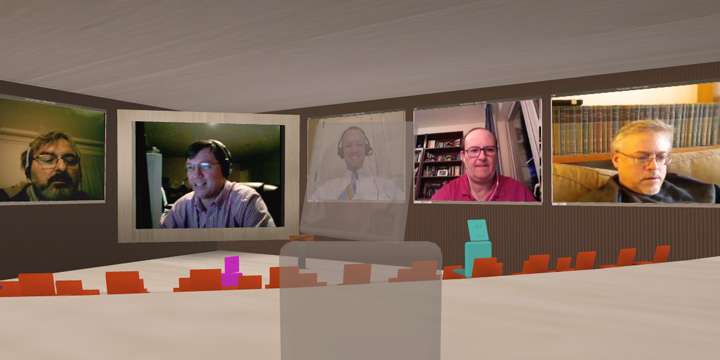
Some speakers in the pictures above.
Program: Turing Church online workshop 2 | KurzweilAI
Speakers, morning session, 9am PST to noon PST:
- Giulio Prisco
- James Hughes
- Martine Rothblatt
- Frank Tipler
- Ben Goertzel
- Remi Sussan
- Lincoln Cannon
- Brent Allsop
- Dan Massey
- Andrew Warner
- Mike Perry
- Fred and Linda Chamberlain (pre-recorded talk)
Saturday, October 22, 2011
Back from trip to NYC and Vermont
In the picture taken by my daughter I am in the New York subway with my late lamented Terasem travel bag, which was stolen by an asshole on the Amtrak train to Vermont. To the asshole: I guess you can make some money by selling the computers and cellphones in the bag, and there was some cash too, but I hope you spend it all on diarrhea pills.
I was a few days in Vermont where I attended the Terasem monthly gathering and annual graduation. In the video below I listen to Martine Rothblatt who talks of satellite radio, electric cars and solar energy... driving an electric sport car powered by solar energy in beautiful Vermont. Awesome.
On Cctober 13 I gave a talk on Transhumanism and Religion at Manhattan College. Thanks to Robert Geraci for organizing the talk, and thanks to all participants for the great questions and comments.
On October 15 and 16 I attended the Singularity Summit 2011. See my Singularity Summit 2011 roundup report at KurzweilAI.
In the picture below I am with my good friend Guillermo Santamaria, whom I met at the Summit face to face for the first time. I met many other friends face to face for the first time, including Robert Geraci and Rachel Haywire, who is organizing the Extreme Futurist Festival in December in LA to bridge counterculture and academia ("if the original Burning Man was to meet the Singularity Summit, you would have Extreme Futurist Fest 2011"). An event not to be missed (though I am afraid I will have to miss it).
I was happy to meet again many good friends (too many to list). A special mention to Alison Gardner and Dan Massey (please see their website VenusPlusX and support their work), who also came to my talk on October 13. After David Brin's talk at the Singularity Summit (David said that the Singularity community should seek a dialog with religious people), Dan and I agreed that the religion of Science and the religion of Love are one and the same, or at least they should be.
Tuesday, September 27, 2011
My talk on Transhumanism and Religion, Manhattan College, Thursday, October 13, 2011 at 4pm
I gave a talk on Transhumanism and Religion at Manhattan College, Thursday, October 13, 2011. Thanks to Robert Geraci for organizing the talk, and thanks to all participants for the great questions and comments.
Slides of the talk:
Slides of the talk:
Transhumanism and Religion
View more presentations from Giulio Prisco
Friday, July 8, 2011
Transhumanism: a “secular spirituality” of life extension and cosmic consciousness finds mainstream hearing
RELIGIOSCOPE has an interesting article on "Transhumanism: a “secular spirituality” of life extension and cosmic consciousness finds mainstream hearing": "A broad-based movement pressing for life extension and radically enhancing human consciousness through technology is gaining mainstream support and adopting a unique kind of “secular spirituality.”"
The article is centered on the field work of Abou Farman (City University of New York) who, at a conference on non-institutional spirituality at Columbia University in New York, presented a paper on a fast-growing network of technological thinkers and groups that he called “informatic futurists” that both borrow concepts from religion and spirituality while seeing themselves in competition with traditional faiths. Farman is also the author of "The Intelligent Universe": "The next stage in evolution -- a machine consciousness able to manipulate time and space -- is just around the corner. The catch: humans will no longer be in charge."
The conclusion of the RELIGIOSCOPE article: "Farman says that the influence of the informatics futurists and their promotion of a convergence between science and human consciousness will “shape more and more of our lives, whether it be through neuroscience research, NSF priorities, Silicon Valley venture capital or popular conferences and ideas.” These challenges will likely change the shape of the relationship between religion and secularism. He concludes that it may be the case that “secular humanism and religion will find each other closer than ever before as the informatic cosmologists try and move away from both gods and humans, as well as from the earth itself.”"
The article is centered on the field work of Abou Farman (City University of New York) who, at a conference on non-institutional spirituality at Columbia University in New York, presented a paper on a fast-growing network of technological thinkers and groups that he called “informatic futurists” that both borrow concepts from religion and spirituality while seeing themselves in competition with traditional faiths. Farman is also the author of "The Intelligent Universe": "The next stage in evolution -- a machine consciousness able to manipulate time and space -- is just around the corner. The catch: humans will no longer be in charge."
The conclusion of the RELIGIOSCOPE article: "Farman says that the influence of the informatics futurists and their promotion of a convergence between science and human consciousness will “shape more and more of our lives, whether it be through neuroscience research, NSF priorities, Silicon Valley venture capital or popular conferences and ideas.” These challenges will likely change the shape of the relationship between religion and secularism. He concludes that it may be the case that “secular humanism and religion will find each other closer than ever before as the informatic cosmologists try and move away from both gods and humans, as well as from the earth itself.”"
Tuesday, June 28, 2011
Engineering Transcendence: Addendum from 2011
My article "Engineering Transcendence: Addendum from 2011" has just been published on H+ Magazine. In this sequel to my old article "Engineering Transcendence" I discuss transhumanist spirituality, its parallels with religions and its potential as a better alternative to religion. The inspiring picture above is taken from Extropia DaSilva's very good follow-up post, also posted to KurzweilAI Forums with some interesting comments.
Saturday, June 25, 2011
Magical thinking
What the fuck is wrong with magical thinking? It is what got Columbus to America.
This has been my first reaction to the article What’s the Likelihood of the Singularity? Part One: Artificial Intelligence, by Alex Knapp on Forbes.
I define magical thinking as imagination applied to overcoming obstacles that are very difficult (or impossible) to overcome according to current science and common sense. Science and common sense used to say that you cannot fly and you cannot talk to people far away, but magical thinking gave us the telegraph, the telephone, air travel, the Internet, mobile phones and Facebook. And I am confident that someday before the end of the century magical thinking will give us brain implants, telepathy and mind uploading. There are many comments to the Forbes article by transhumanist friends (notably, some very cogent comments by Ben Goertzel) who insist that transhumanism is not magical thinking. Well, I think it is - magical thinking in its purest and noblest form, the kind of magical thinking that has taken us from caves to the Moon, and will take us to the stars and beyond.
Note on mind uplaoding: The second part of the article What’s the Likelihood of the Singularity? Part Two: Uploading the Brain is just out. I will just make one comment at this moment: denying the possibility of mind uploading is crude dualism, because it assumes that carbon biology has some mystical property that science will never be able to explain and engineering will never be able to replicate and improve. With this attitude, we would be still living in caves. I will to comment to both articles and I have just created an account on Forbes.
Both articles are inspired by an article by Charlie Stross on Three arguments against the singularity. The article is very interesting and written by someone who understands these things much better than Knapp. I just left this comment:
Charlie, I am more optimist than you on the feasibility of and timeline for strong AI and mind uploading, but I am probably closer to your cautious assessment than to the wild optimism of, say, Kurzweil. I think both technologies will be developed someday because they are compatible with our scientific understanding of reality, but not very soon.
In reply to: "I can't disprove [the Simulation Argument], either. And it has a deeper-than-superficial appeal, insofar as it offers a deity-free afterlife... it would make a good free-form framework for a postmodern high-tech religion. Unfortunately it seems to be unfalsifiable, at least by the inmates (us)."
My question is, what is wrong with this. Some persons function better _in this life_ if they can persuade themselves to contemplate the possibility of an afterlife compatible with the scientific worldview. They become happier and better persons, help others, and try to make the world a better place.
In other words, the pursuit of personal happiness without harming others. Charlie, what the fuck is wrong with this?
Read Charlie's reply and many other interesting comments on Charlie's blog.
Now also the third article of Knapp's series is out: What’s the Likelihood of the Singularity? Part Three: A Simulated World. There is an interesting discussion on quantum mechanics, of all things. My last comment:
According to the Copenhagen interpretation of quantum mechanics, the universe does not compute things that nobody is observing, but leaves them in a undetermined state to be defined only when somebody actually observes them. This makes sense from a computational perspective (why waste useful resources to compute useless things?) and this is why we use the same strategy in our own synthetic worlds like World of Warcraft. So, without stretching the analogy too far, I rather consider quantum mechanics as suggestive evidence in favor of a simulation theory.
This has been my first reaction to the article What’s the Likelihood of the Singularity? Part One: Artificial Intelligence, by Alex Knapp on Forbes.
I define magical thinking as imagination applied to overcoming obstacles that are very difficult (or impossible) to overcome according to current science and common sense. Science and common sense used to say that you cannot fly and you cannot talk to people far away, but magical thinking gave us the telegraph, the telephone, air travel, the Internet, mobile phones and Facebook. And I am confident that someday before the end of the century magical thinking will give us brain implants, telepathy and mind uploading. There are many comments to the Forbes article by transhumanist friends (notably, some very cogent comments by Ben Goertzel) who insist that transhumanism is not magical thinking. Well, I think it is - magical thinking in its purest and noblest form, the kind of magical thinking that has taken us from caves to the Moon, and will take us to the stars and beyond.
Note on mind uplaoding: The second part of the article What’s the Likelihood of the Singularity? Part Two: Uploading the Brain is just out. I will just make one comment at this moment: denying the possibility of mind uploading is crude dualism, because it assumes that carbon biology has some mystical property that science will never be able to explain and engineering will never be able to replicate and improve. With this attitude, we would be still living in caves. I will to comment to both articles and I have just created an account on Forbes.
Both articles are inspired by an article by Charlie Stross on Three arguments against the singularity. The article is very interesting and written by someone who understands these things much better than Knapp. I just left this comment:
Charlie, I am more optimist than you on the feasibility of and timeline for strong AI and mind uploading, but I am probably closer to your cautious assessment than to the wild optimism of, say, Kurzweil. I think both technologies will be developed someday because they are compatible with our scientific understanding of reality, but not very soon.
In reply to: "I can't disprove [the Simulation Argument], either. And it has a deeper-than-superficial appeal, insofar as it offers a deity-free afterlife... it would make a good free-form framework for a postmodern high-tech religion. Unfortunately it seems to be unfalsifiable, at least by the inmates (us)."
My question is, what is wrong with this. Some persons function better _in this life_ if they can persuade themselves to contemplate the possibility of an afterlife compatible with the scientific worldview. They become happier and better persons, help others, and try to make the world a better place.
In other words, the pursuit of personal happiness without harming others. Charlie, what the fuck is wrong with this?
Read Charlie's reply and many other interesting comments on Charlie's blog.
Now also the third article of Knapp's series is out: What’s the Likelihood of the Singularity? Part Three: A Simulated World. There is an interesting discussion on quantum mechanics, of all things. My last comment:
According to the Copenhagen interpretation of quantum mechanics, the universe does not compute things that nobody is observing, but leaves them in a undetermined state to be defined only when somebody actually observes them. This makes sense from a computational perspective (why waste useful resources to compute useless things?) and this is why we use the same strategy in our own synthetic worlds like World of Warcraft. So, without stretching the analogy too far, I rather consider quantum mechanics as suggestive evidence in favor of a simulation theory.
Saturday, February 12, 2011
Technological Transcendence: An Interview with Giulio Prisco, on H+ Magazine
Technological Transcendence: An Interview with Giulio Prisco, by Ben Goertzel, is on H+ Magazine.
From Ben's introduction: "While transhumanism differs from traditional religions in being based around reason more centrally than faith, it does have some commonality in terms of presenting a broad vision of the universe, with implications on the intellectual level but also for everyday life. And it does present at least some promise of achieving via science some of the more radical promises that religion has traditionally offered -- immortality, dramatic states of bliss, maybe even resurrection. A host of transhumanist thinkers have explored the connections between transhumanism and spirituality, seeking to do so in a manner that pays proper respect to both"
From me: "Our universe is a very big place with lots of undiscovered and unimagined “things in heaven and earth” which science will uncover someday, and perhaps in this mysterious and beautiful complexity there is room for spirituality and even for the old promises of religions, such as immortality and resurrection... I am persuaded that these glimpses into veiled future possibilities are basically compatible with our best understanding of how the universe really works. And they give me beautiful visions of future worlds, and the hope, drive and energy that I need to try living a good and productive life, in this world. And this, I believe, is what really matters." The interview is long, and we discuss many related ideas and the work of spiritually inclined transhumanist groups such as the Turing Church, Terasem, the Society for Universal Immortalism, and the Mormon Transhumanist Association.
At the end Ben gives some very interesting ideas "about how to start a Confederation of Cosmists – i.e. some sort of active organization centered around Cosmism aka “strong transhumanism” as a practical philosophy. Not a religion but something vaguely analogous to a religion, founded on rational radical transhumanism rather than traditional faiths."
I have written a lot on transhumanist spirituality, but I have often been misunderstood, which probably means that I have never been clear enough. I hope in this interview, and with Ben's valuable help, I have managed to be more clear.
From Ben's introduction: "While transhumanism differs from traditional religions in being based around reason more centrally than faith, it does have some commonality in terms of presenting a broad vision of the universe, with implications on the intellectual level but also for everyday life. And it does present at least some promise of achieving via science some of the more radical promises that religion has traditionally offered -- immortality, dramatic states of bliss, maybe even resurrection. A host of transhumanist thinkers have explored the connections between transhumanism and spirituality, seeking to do so in a manner that pays proper respect to both"
From me: "Our universe is a very big place with lots of undiscovered and unimagined “things in heaven and earth” which science will uncover someday, and perhaps in this mysterious and beautiful complexity there is room for spirituality and even for the old promises of religions, such as immortality and resurrection... I am persuaded that these glimpses into veiled future possibilities are basically compatible with our best understanding of how the universe really works. And they give me beautiful visions of future worlds, and the hope, drive and energy that I need to try living a good and productive life, in this world. And this, I believe, is what really matters." The interview is long, and we discuss many related ideas and the work of spiritually inclined transhumanist groups such as the Turing Church, Terasem, the Society for Universal Immortalism, and the Mormon Transhumanist Association.
At the end Ben gives some very interesting ideas "about how to start a Confederation of Cosmists – i.e. some sort of active organization centered around Cosmism aka “strong transhumanism” as a practical philosophy. Not a religion but something vaguely analogous to a religion, founded on rational radical transhumanism rather than traditional faiths."
I have written a lot on transhumanist spirituality, but I have often been misunderstood, which probably means that I have never been clear enough. I hope in this interview, and with Ben's valuable help, I have managed to be more clear.
Tuesday, December 14, 2010
VIDEO - my talk on The Cosmic Visions of the Turing Church at the Transhumanism and Spirituality Conference 2010
The video of my talk on The Cosmic Visions of the Turing Church (at the Transhumanism and Spirituality Conference 2010) is online on Vimeo. The conference explored the intersection of religion, science, spirituality and technology, from a transhumanist perspective. See this post for the slides of the talk on Slideshare. I also gave a similar talk at the Turing Church Online Workshop 1 on November 20, 2010.
Sunday, November 21, 2010
The Turing Church of transhumanist spirituality, online in virtual reality for people and pets
The Turing Church Online Workshop 1, on Saturday November 20 2010 in Teleplace, explored transhumanist spirituality and “Religion 2.0″ as a coordination-oriented summit of persons, groups and organizations active in this area. See my report with pictures and videos.
Here I prefer to show this picture of three participants with their pets before the formal start of the workshop. On the left video screen I am holding my sweet little Sacha, who is NOT a cat like the other two pets but a Shih-Tzu doggy with her own Facebook page. En passant, last week we webcast Sacha's 12th birthday party on Facebook via Livestream, see the picture below and the video on YouTube.
Back to the Turing Church Online Workshop 1. Topics and issues discussed:
- To discover parallels and similarities between different organizations and to agree on common interests, agendas, strategies, outreach plans etc.
- To discuss whether it makes sense to establish a umbrella organization, or to consider one of the existing organizations as such.
- To develop the idea of scientific resurrection: our descendants and mind children will develop “magic science and technology” in the sense of Clarke’s third law, and may be able to do grand spacetime engineering and even resurrect the dead by “copying them to the future“. Of course this a hope and not a certainty, but I am persuaded that this concept is scientifically founded and could become the “missing link” between transhumanists and religious and spiritual communities.
- And of course, how to make our our beautiful ideas available, understandable and appealing to billions of seekers.
The workshop made evident that the participants, persons and groups, share very similar, overlapping and compatible ideas. It is also evident that there are different approaches to transhumanist spirituality, each with its own focus and priorities. Some participants observed that, since all of the spiritual transhumanist groups represented at the workshop are inclusive, it makes sense joining all (I am a member of all the groups represented at the workshop which have a formal concept of membership, and I consider myself a member of the others as well). The idea of establishing a umbrella organizations for spiritually inclined transhumanists was discussed. An alternative is one of the existing groups, or perhaps Humanity+ (subject to their interest of course) as umbrella organization. The MTA and Terasem reported significant growth.
My own presentation was very similar to my talk on The Cosmic Visions of the Turing Church at the Transhumanism and Spirituality Conference 2010, with some new elements. In particular I added a few references to Possibilianism, a middle, exploratory ground between religion and atheism first defined by neuroscientist David Eagleman in relation to his book of fiction Sum. Eagleman: "I call myself a Possibilian: I'm open to ideas that we don't have any way of testing right now... Our ignorance of the cosmos is too vast to commit to atheism, and yet we know too much to commit to a particular religion… with Possibilianism I'm hoping to define a new position -- one that emphasizes the exploration of new, unconsidered possibilities. Possibilianism is comfortable holding multiple ideas in mind; it is not interested in committing to any particular story." This makes a lot of sense to me, and I consider myself as a Possibilianist and a Cosmist. Our universe is a very big place with lots of undiscovered and unimagined "things in heaven and earth" which science will uncover someday, and perhaps in this mysterious and beautiful complexity there will be room for the old promises of religion.
This was a great workshop of 4 very intense hours and a lot of interesting things were said. I don't have the time to write a full report, please watch the videos.
Here I prefer to show this picture of three participants with their pets before the formal start of the workshop. On the left video screen I am holding my sweet little Sacha, who is NOT a cat like the other two pets but a Shih-Tzu doggy with her own Facebook page. En passant, last week we webcast Sacha's 12th birthday party on Facebook via Livestream, see the picture below and the video on YouTube.
Back to the Turing Church Online Workshop 1. Topics and issues discussed:
- To discover parallels and similarities between different organizations and to agree on common interests, agendas, strategies, outreach plans etc.
- To discuss whether it makes sense to establish a umbrella organization, or to consider one of the existing organizations as such.
- To develop the idea of scientific resurrection: our descendants and mind children will develop “magic science and technology” in the sense of Clarke’s third law, and may be able to do grand spacetime engineering and even resurrect the dead by “copying them to the future“. Of course this a hope and not a certainty, but I am persuaded that this concept is scientifically founded and could become the “missing link” between transhumanists and religious and spiritual communities.
- And of course, how to make our our beautiful ideas available, understandable and appealing to billions of seekers.
The workshop made evident that the participants, persons and groups, share very similar, overlapping and compatible ideas. It is also evident that there are different approaches to transhumanist spirituality, each with its own focus and priorities. Some participants observed that, since all of the spiritual transhumanist groups represented at the workshop are inclusive, it makes sense joining all (I am a member of all the groups represented at the workshop which have a formal concept of membership, and I consider myself a member of the others as well). The idea of establishing a umbrella organizations for spiritually inclined transhumanists was discussed. An alternative is one of the existing groups, or perhaps Humanity+ (subject to their interest of course) as umbrella organization. The MTA and Terasem reported significant growth.
My own presentation was very similar to my talk on The Cosmic Visions of the Turing Church at the Transhumanism and Spirituality Conference 2010, with some new elements. In particular I added a few references to Possibilianism, a middle, exploratory ground between religion and atheism first defined by neuroscientist David Eagleman in relation to his book of fiction Sum. Eagleman: "I call myself a Possibilian: I'm open to ideas that we don't have any way of testing right now... Our ignorance of the cosmos is too vast to commit to atheism, and yet we know too much to commit to a particular religion… with Possibilianism I'm hoping to define a new position -- one that emphasizes the exploration of new, unconsidered possibilities. Possibilianism is comfortable holding multiple ideas in mind; it is not interested in committing to any particular story." This makes a lot of sense to me, and I consider myself as a Possibilianist and a Cosmist. Our universe is a very big place with lots of undiscovered and unimagined "things in heaven and earth" which science will uncover someday, and perhaps in this mysterious and beautiful complexity there will be room for the old promises of religion.
This was a great workshop of 4 very intense hours and a lot of interesting things were said. I don't have the time to write a full report, please watch the videos.
Sunday, November 7, 2010
Turing Church Online Workshop 1, Teleplace, Saturday November 20, 9am-1pm PST
Turing Church Online Workshop 1, in Teleplace, Saturday November 20, 9am-1pm PST (noon-4pm EST, 5pm-9pm UK, 6pm-10pm EU). The workshop will explore transhumanist spirituality and "Religion 2.0" and it will be a coordination-oriented summit of groups and organizations active in this area.
Format:
Online-only workshop in Teleplace. Those who already have Teleplace accounts for teleXLR8 can just show up at the workshop. There are a limited number of seats available for others, please contact me if you wish to attend.
Panelists:
- Lincoln Cannon (Mormon Transhumanist Association)
- Ben Goertzel (Cosmist Manifesto)
- Mike Perry (Society for Universal Immortalism)
- Giulio Prisco (Turing Church)
- Martine Rothblatt (Terasem)
Agenda:
- Talks by the panelists in the first 2 hours.
- Discussion between the panelists in the last 2 hours, with the participation of the audience.
Objectives:
- To discover parallels and similarities between different organizations and to agree on common interests, agendas, strategies, outreach plans etc.
- To discuss whether it makes sense to establish a umbrella organization, or to consider one of the existing organizations as such.
- To develop the idea of scientific resurrection: our descendants and mind children will develop “magic science and technology” in the sense of Clarke’s third law, and may be able to do grand spacetime engineering and even resurrect the dead by “copying them to the future“. Of course this a hope and not a certainty, but I am persuaded that this concept is scientifically founded and could become the “missing link” between transhumanists and religious and spiritual communities.
- And of course, how to make our our beautiful ideas available, understandable and appealing to billions of seekers.
My own presentation will be a revised and expanded version of my talk on The Cosmic Visions of the Turing Church at the Transhumanism and Spirituality Conference 2010. The main point can be summarized in one sentence (Slide 4): "A memetically strong religion needs to offer resurrection besides immortality."
Format:
Online-only workshop in Teleplace. Those who already have Teleplace accounts for teleXLR8 can just show up at the workshop. There are a limited number of seats available for others, please contact me if you wish to attend.
Panelists:
- Lincoln Cannon (Mormon Transhumanist Association)
- Ben Goertzel (Cosmist Manifesto)
- Mike Perry (Society for Universal Immortalism)
- Giulio Prisco (Turing Church)
- Martine Rothblatt (Terasem)
Agenda:
- Talks by the panelists in the first 2 hours.
- Discussion between the panelists in the last 2 hours, with the participation of the audience.
Objectives:
- To discover parallels and similarities between different organizations and to agree on common interests, agendas, strategies, outreach plans etc.
- To discuss whether it makes sense to establish a umbrella organization, or to consider one of the existing organizations as such.
- To develop the idea of scientific resurrection: our descendants and mind children will develop “magic science and technology” in the sense of Clarke’s third law, and may be able to do grand spacetime engineering and even resurrect the dead by “copying them to the future“. Of course this a hope and not a certainty, but I am persuaded that this concept is scientifically founded and could become the “missing link” between transhumanists and religious and spiritual communities.
- And of course, how to make our our beautiful ideas available, understandable and appealing to billions of seekers.
My own presentation will be a revised and expanded version of my talk on The Cosmic Visions of the Turing Church at the Transhumanism and Spirituality Conference 2010. The main point can be summarized in one sentence (Slide 4): "A memetically strong religion needs to offer resurrection besides immortality."
Wednesday, October 6, 2010
My favorite Dawkins quote
Via the Transcript of Lincoln Cannon's Presentation at Transhumanism and Spirituality Conference 2010: In his book, "The God Delusion", the talented evolutionary biologist and leading voice of the New Atheist movement, Richard Dawkins, writes:
"Whether we ever get to know them or not, there are very probably alien civilizations that are superhuman, to the point of being god-like in ways that exceed anything a theologian could possibly imagine. Their technical achievements would seem as supernatural to us as ours would seem to a Dark Age peasant transported to the twenty-first century. Imagine his response to a laptop computer, a mobile telephone, a hydrogen bomb or a jumbo jet. As Arthur C Clarke put it, in his Third Law: 'Any sufficiently advanced technology is indistinguishable from magic.' The miracles wrought by our technology would have seemed to the ancients no less remarkable than the tales of Moses parting the waters, or Jesus walking upon them. The aliens of our SETI signal would be to us like gods . . . In what sense, then, would the most advanced SETI aliens not be gods? In what sense would they be superhuman but not supernatural? In a very important sense, which goes to the heart of this book. The crucial difference between gods and god-like extraterrestrials lies not in their properties but in their provenance. Entities that are complex enough to be intelligent are products of an evolutionary process. No matter how god-like they may seem when we encounter them, they didn't start that way. Science-fiction authors . . . have even suggested (and I cannot think how to disprove it) that we live in a computer simulation, set up by some vastly superior civilization. But the simulators themselves would have to come from somewhere. The laws of probability forbid all notions of their spontaneously appearing without simpler antecedents. They probably owe their existence to a (perhaps unfamiliar) version of Darwinian evolution..."
Of course, I completely agree with Dawkins and these are precisely the arguments that we use in support of a new transhumanist spirituality or, if you like, religion. See for example my own presentation at the Transhumanism and Spirituality Conference 2010, titled "The Cosmic Visions of the Turing Church".
"Whether we ever get to know them or not, there are very probably alien civilizations that are superhuman, to the point of being god-like in ways that exceed anything a theologian could possibly imagine. Their technical achievements would seem as supernatural to us as ours would seem to a Dark Age peasant transported to the twenty-first century. Imagine his response to a laptop computer, a mobile telephone, a hydrogen bomb or a jumbo jet. As Arthur C Clarke put it, in his Third Law: 'Any sufficiently advanced technology is indistinguishable from magic.' The miracles wrought by our technology would have seemed to the ancients no less remarkable than the tales of Moses parting the waters, or Jesus walking upon them. The aliens of our SETI signal would be to us like gods . . . In what sense, then, would the most advanced SETI aliens not be gods? In what sense would they be superhuman but not supernatural? In a very important sense, which goes to the heart of this book. The crucial difference between gods and god-like extraterrestrials lies not in their properties but in their provenance. Entities that are complex enough to be intelligent are products of an evolutionary process. No matter how god-like they may seem when we encounter them, they didn't start that way. Science-fiction authors . . . have even suggested (and I cannot think how to disprove it) that we live in a computer simulation, set up by some vastly superior civilization. But the simulators themselves would have to come from somewhere. The laws of probability forbid all notions of their spontaneously appearing without simpler antecedents. They probably owe their existence to a (perhaps unfamiliar) version of Darwinian evolution..."
Of course, I completely agree with Dawkins and these are precisely the arguments that we use in support of a new transhumanist spirituality or, if you like, religion. See for example my own presentation at the Transhumanism and Spirituality Conference 2010, titled "The Cosmic Visions of the Turing Church".
Friday, October 1, 2010
My talk tonight at the Transhumanism and Spirituality Conference 2010
UPDATE with slides and video clip: The Cosmic Visions of the Turing Church
Tonight I will give a talk at the Transhumanism and Spirituality Conference 2010. The conference will explore the intersection of religion, science, spirituality and technology, from a transhumanist perspective. Transhumanism advocates the ethical use of technology to expand human capacities, and observes that if our rapid technological evolution continues to accelerate then humanity will become a new species before the end of the 21st century.
I will give a talk on The Cosmic Visions of the Turing Church. Abstract: Following the Turing-Church conjecture, minds can be uploaded from biological brains to other computational substrates. Mind uploading research may achieve practical results within decades. Given the technology, humans may live indefinitely, colonizing the universe, and resurrecting the dead by "copying them to the future". Perhaps they will create synthetic realities inhabited by sentient minds; perhaps we are in a synthetic reality. These considerations parallel the tenets of many religions. The Turing Church will be a meta-religion, without central doctrine, characterized by common interest in the promised land where science and religion meet, science becomes religion, and religion becomes science.
I will talk remotely to the audience at the University of Utah in Salt Lake City and to those who will watch the live stream of the conference. I wish to thank the organizers for setting up the live stream, this should be done for all conferences. This is the stream URL, please come to watch all talks and participate in the discussions. After the talk I will post my slides here, and I understand that the videos of all talks will be available online after the conference.
Tonight I will give a talk at the Transhumanism and Spirituality Conference 2010. The conference will explore the intersection of religion, science, spirituality and technology, from a transhumanist perspective. Transhumanism advocates the ethical use of technology to expand human capacities, and observes that if our rapid technological evolution continues to accelerate then humanity will become a new species before the end of the 21st century.
I will give a talk on The Cosmic Visions of the Turing Church. Abstract: Following the Turing-Church conjecture, minds can be uploaded from biological brains to other computational substrates. Mind uploading research may achieve practical results within decades. Given the technology, humans may live indefinitely, colonizing the universe, and resurrecting the dead by "copying them to the future". Perhaps they will create synthetic realities inhabited by sentient minds; perhaps we are in a synthetic reality. These considerations parallel the tenets of many religions. The Turing Church will be a meta-religion, without central doctrine, characterized by common interest in the promised land where science and religion meet, science becomes religion, and religion becomes science.
I will talk remotely to the audience at the University of Utah in Salt Lake City and to those who will watch the live stream of the conference. I wish to thank the organizers for setting up the live stream, this should be done for all conferences. This is the stream URL, please come to watch all talks and participate in the discussions. After the talk I will post my slides here, and I understand that the videos of all talks will be available online after the conference.
Sunday, September 26, 2010
Transhumanism and Spirituality Conference 2010
When: Friday, 1 October 2010, 9:00am to 5:00pm MDT
Where: University of Utah in Salt Lake City, Marriott Library, Gould Auditorium
What: At the Transhumanism and Spirituality Conference 2010, we will explore the intersection of religion, science, spirituality and technology, from a transhumanist perspective. Transhumanism advocates the ethical use of technology to expand human capacities, and observes that if our rapid technological evolution continues to accelerate then humanity will become a new species before the end of the 21st century.
Who: Keynote speakers for the conference include former director of the World Transhumanist Association, James Hughes; author of the Transhumanist Manifesto, Max More; and renowned LDS scholar and author, Terryl Givens. Sponsors of the conference are the Mormon Transhumanist Association and the Transhumanist Alliance of Utah.
How: Register online (http://transhumanism-spirituality.org) for a discount and reserved seating! Online registration is $50 ($25 for students) until 29 September. Registration on the day of the conference will be $80. Students with ID will be admitted to the conference free of charge, as space permits. Students wishing reserved seating are encouraged to register at the discounted student rate.
Where: University of Utah in Salt Lake City, Marriott Library, Gould Auditorium
What: At the Transhumanism and Spirituality Conference 2010, we will explore the intersection of religion, science, spirituality and technology, from a transhumanist perspective. Transhumanism advocates the ethical use of technology to expand human capacities, and observes that if our rapid technological evolution continues to accelerate then humanity will become a new species before the end of the 21st century.
Who: Keynote speakers for the conference include former director of the World Transhumanist Association, James Hughes; author of the Transhumanist Manifesto, Max More; and renowned LDS scholar and author, Terryl Givens. Sponsors of the conference are the Mormon Transhumanist Association and the Transhumanist Alliance of Utah.
How: Register online (http://transhumanism-spirituality.org) for a discount and reserved seating! Online registration is $50 ($25 for students) until 29 September. Registration on the day of the conference will be $80. Students with ID will be admitted to the conference free of charge, as space permits. Students wishing reserved seating are encouraged to register at the discounted student rate.
Sunday, May 2, 2010
Has Transhumansim already won?
Comments to Michael Anissimov's Transhumanism Has Already Won and TransAlchemy's If Transhumanism Has Won, Who Lost?:
I agree with Michael's first statement: "It’s 2010, and transhumanism has already won. Billions of people around the world would love to upgrade their bodies, extend their youth, and amplify their powers of perception, thought, and action with the assistance of safe and tested technologies. The urge to be something more, to go beyond, is the norm rather than the exception."
Transhumanism wins by disappearing into the fabric of daily routine. As enhancement products become available, if they can really improve the quality of life consumers will buy them, regardless of the whining of "bio-ethicists". Soon we will have brain implants to boost our cognitive abilities, and later we will be able to become post-biological beings with indefinite lifespans via mind uploading. Once these options are available, many people will use them without paying attention to big philosophical words. For our generation, sending the first email was something momentous - but today's kids just use Facebook on their Iphones. And this is how it should be. Tomorrow's kids will just use their brain implants and merge with software. The Singularity will happen, but it will feel like daily routine.
Mike Treder writes: "That’s why, 20 years from now, transhumanism might be largely forgotten--because everyone will be a transhumanist. Though, of course, they won’t call themselves that. As Giulio Prisco puts it, 'That would mean transhumanism, once revolutionary and disruptive, has dissolved into the fabric of the zeitgeist, and everyone just assumes that human enhancement and transcendence of all limits is good.'"
Michael continues: "At their base, the world’s major two largest religions — Christianity and Islam — are transhumanistic. After all, they promise transcension from death and the concerns of the flesh, and being upgraded to that archetypical transhuman — the Angel... We will plant flowers and trees across the universe. All we have to do is survive our embryonic stage, stay in control of our own destiny, and expand outwards in every direction at the speed of light."
I also agree with this. The smartest strategy for traditional religious at this moment, would be to begin integrating transhumanism in their doctrine (like the Mormon Transhumanist Association). Of course they will not do this, yet, because they are power systems, they understand very well that transhumanism can be a very powerful competitor in their memetic space, and they want to preserve their power and money. Therefore, they will continue to try fighting transhumanism until is too late.
TransAlchemy is a team of two anti-transhumanist activists who publish an interesting blog and video podcast. I must admit to reading and watching them often: they are often interesting, and they often seem to understand transhumanism perhaps better than many transhumanists. They are Terrans who wish to "Save the Humans" and fight Cosmists. But the "[Angels who]... expand outwards in every direction at the speed of light" are humans: they are the next phase of the evolution of our species. They are our children, and you don't fight your children, because it would be fighting yourself.
However, TransAlchemy say: "We must accept the possibility that there is a probability, greater than 0%, that "God exists"... As transhuman-centric technologies will aim to keep you trapped within the comfortable boundaries of this universe, religions would seek to return to the creator of the universe."
I accept the possibility that perhaps God exists, in a certain sense: one or more Gods who evolved naturally (that is, not supernaturally), but created our world as a synthetic reality (we may be NPCs in their videogames) and can intervene in our reality in ways that we could only call supernatural (they cannot violate their own physics, but they can violate the simulated physics of our reality). Perhaps they will resurrect us all in a better simulation.
But transhumanists don't accept limits, not even "the comfortable boundaries of this universe". If there are ways to reach beyond, we will try to use our engineering ability to reach beyond when the time is right, and "seek to return to the creator of the universe". And of course I cannot even begin to speculate about the motivations of super-intelligent beings, but I know one thing: if we could create synthetic realities inhabited by sentient beings, I would hope that one day they find out how to talk to us as equals. The plan of God may be that we become Gods.
I agree with Michael's first statement: "It’s 2010, and transhumanism has already won. Billions of people around the world would love to upgrade their bodies, extend their youth, and amplify their powers of perception, thought, and action with the assistance of safe and tested technologies. The urge to be something more, to go beyond, is the norm rather than the exception."
Transhumanism wins by disappearing into the fabric of daily routine. As enhancement products become available, if they can really improve the quality of life consumers will buy them, regardless of the whining of "bio-ethicists". Soon we will have brain implants to boost our cognitive abilities, and later we will be able to become post-biological beings with indefinite lifespans via mind uploading. Once these options are available, many people will use them without paying attention to big philosophical words. For our generation, sending the first email was something momentous - but today's kids just use Facebook on their Iphones. And this is how it should be. Tomorrow's kids will just use their brain implants and merge with software. The Singularity will happen, but it will feel like daily routine.
Mike Treder writes: "That’s why, 20 years from now, transhumanism might be largely forgotten--because everyone will be a transhumanist. Though, of course, they won’t call themselves that. As Giulio Prisco puts it, 'That would mean transhumanism, once revolutionary and disruptive, has dissolved into the fabric of the zeitgeist, and everyone just assumes that human enhancement and transcendence of all limits is good.'"
Michael continues: "At their base, the world’s major two largest religions — Christianity and Islam — are transhumanistic. After all, they promise transcension from death and the concerns of the flesh, and being upgraded to that archetypical transhuman — the Angel... We will plant flowers and trees across the universe. All we have to do is survive our embryonic stage, stay in control of our own destiny, and expand outwards in every direction at the speed of light."
I also agree with this. The smartest strategy for traditional religious at this moment, would be to begin integrating transhumanism in their doctrine (like the Mormon Transhumanist Association). Of course they will not do this, yet, because they are power systems, they understand very well that transhumanism can be a very powerful competitor in their memetic space, and they want to preserve their power and money. Therefore, they will continue to try fighting transhumanism until is too late.
TransAlchemy is a team of two anti-transhumanist activists who publish an interesting blog and video podcast. I must admit to reading and watching them often: they are often interesting, and they often seem to understand transhumanism perhaps better than many transhumanists. They are Terrans who wish to "Save the Humans" and fight Cosmists. But the "[Angels who]... expand outwards in every direction at the speed of light" are humans: they are the next phase of the evolution of our species. They are our children, and you don't fight your children, because it would be fighting yourself.
However, TransAlchemy say: "We must accept the possibility that there is a probability, greater than 0%, that "God exists"... As transhuman-centric technologies will aim to keep you trapped within the comfortable boundaries of this universe, religions would seek to return to the creator of the universe."
I accept the possibility that perhaps God exists, in a certain sense: one or more Gods who evolved naturally (that is, not supernaturally), but created our world as a synthetic reality (we may be NPCs in their videogames) and can intervene in our reality in ways that we could only call supernatural (they cannot violate their own physics, but they can violate the simulated physics of our reality). Perhaps they will resurrect us all in a better simulation.
But transhumanists don't accept limits, not even "the comfortable boundaries of this universe". If there are ways to reach beyond, we will try to use our engineering ability to reach beyond when the time is right, and "seek to return to the creator of the universe". And of course I cannot even begin to speculate about the motivations of super-intelligent beings, but I know one thing: if we could create synthetic realities inhabited by sentient beings, I would hope that one day they find out how to talk to us as equals. The plan of God may be that we become Gods.
Saturday, April 24, 2010
Turing Church working group
At this moment the Turing Church is a closed working group at the intersection of science and religion. See http://turingchurch.org/ (login required). If you are in general agreement with the ideas in this blog (see the article on Ten Cosmist Convictions) and wish to participate in the working group, send me an email.
Monday, April 19, 2010
Cosmist Manifesto: Discussion on resurrection
Ben Goertzel has invited readers to comment his excellent Cosmist Manifesto. I look forward to seeing the text published as a book, and I will post many comments. There is an interesting discussion on technological resurrection going on in the comment thread of the post Ten Cosmist Convictions (Mostly By Giulio Prisco), please contribute. My first comment:
Many rationalists have knee-jerk reactions when the idea of technological resurrection of the dead is mentioned. Perhaps because they made a big effort to free themselves from religious superstition and are afraid of falling back into religion. But here we are talking about science and technology, not religion.
I consider the resurrection of the dead as a very remote possibility that may, or may not, be developed by future engineers.
May or may not, and how? We just don't know enough. Perhaps by quantum entanglement to the past as Ken suggests (it is known that other times are special cases of other MWI branches), or perhaps by other means. Perhaps those information patterns are dispersed that were our loved ones, as Samantha suggests, or perhaps the unfolding computation which is our reality is reversible up to a certain degree. Perhaps we will be able to acquire sufficient information from the past to "copy the dead from the past to the future", or perhaps not.
In passing note that, if our reality is a simulation running in a higher level of reality, there are conceptually simple resurrection mechanisms (the sysop can copy a pattern to another simulation). This is also a possibility that cannot be ruled out.
I prefer not to try formulating more precise speculations, and limiting myself to contemplating the idea that, perhaps, our universe may be compatible with resurrection of the dead, and our descendants may be able to achieve it. And as a student of science, I don't think resurrection is incompatible with our current knowledge of how the universe works.
All religions have developed the idea of resurrection, and it is simple to understand why: it is one of those ideas that help people getting through the night. It certainly helps me getting through the night, as I don't really expect to see engineered immortality (through biotechnology or mind uploading) in my lifetime.
And getting through the night is what really matters. As William James said, we should feel free to believe in unproven or even unprovable ideas, especially when this belief helps us finding meaning and achieving goals in our actual lives.
Please comment Ben's post Ten Cosmist Convictions (Mostly By Giulio Prisco), not this one.
Many rationalists have knee-jerk reactions when the idea of technological resurrection of the dead is mentioned. Perhaps because they made a big effort to free themselves from religious superstition and are afraid of falling back into religion. But here we are talking about science and technology, not religion.
I consider the resurrection of the dead as a very remote possibility that may, or may not, be developed by future engineers.
May or may not, and how? We just don't know enough. Perhaps by quantum entanglement to the past as Ken suggests (it is known that other times are special cases of other MWI branches), or perhaps by other means. Perhaps those information patterns are dispersed that were our loved ones, as Samantha suggests, or perhaps the unfolding computation which is our reality is reversible up to a certain degree. Perhaps we will be able to acquire sufficient information from the past to "copy the dead from the past to the future", or perhaps not.
In passing note that, if our reality is a simulation running in a higher level of reality, there are conceptually simple resurrection mechanisms (the sysop can copy a pattern to another simulation). This is also a possibility that cannot be ruled out.
I prefer not to try formulating more precise speculations, and limiting myself to contemplating the idea that, perhaps, our universe may be compatible with resurrection of the dead, and our descendants may be able to achieve it. And as a student of science, I don't think resurrection is incompatible with our current knowledge of how the universe works.
All religions have developed the idea of resurrection, and it is simple to understand why: it is one of those ideas that help people getting through the night. It certainly helps me getting through the night, as I don't really expect to see engineered immortality (through biotechnology or mind uploading) in my lifetime.
And getting through the night is what really matters. As William James said, we should feel free to believe in unproven or even unprovable ideas, especially when this belief helps us finding meaning and achieving goals in our actual lives.
Please comment Ben's post Ten Cosmist Convictions (Mostly By Giulio Prisco), not this one.
Sunday, March 28, 2010
In Whom we live, move, and have our being
World of Warcraft's characters often seem intelligent, but human players soon learn that the poor things are hopelessly dumb and can be easily defeated. Other computer games have better AI (Artificial Intelligence), but game AI is still light years behind real intelligence. However, I am persuaded that real, self-aware AGI (Artificial General Intelligence), of human and higher level, will be achieved someday, perhaps by the computer gaming industry itself, and perhaps in the next couple of decades. Then, computer games will contain sentient, intelligent persons like you and I.
If computer game characters can be intelligent and sentient, perhaps we are sentient and intelligent computer game characters? Is our reality, including ourselves in it, a computer simulation? These questions may seem strange at first, but they are not easily dismissed, and philosophers have been asking similar questions for centuries and more. Today, reality as a simulation is a frequent discussion topic in transhumanist interest groups. Who is running the simulation? Perhaps unknowable aliens in another level of reality have invented us and our world, but a frequent assumption is that future humans run our reality as a historically accurate simulation of their past (our present).
Of course we should not imagine the computers simulating our reality as similar to today's computers. No, they will not be more powerful boxes running a slightly better future release of Windows. A computer able to simulate a reality as complex as ours, and containing conscious observers, must be many orders of magnitude more complex and powerful than anything we have today, and probably be based on very different hardware and system software. Many AGI experts think consciousness can, and does, emerge from a sufficiently complex computational system. Many transhumanists believe humans will merge with AGIs once Mind Uploading technology is developed, and super-intelligent human-AGI hybrids will spread to the universe. The last chapter of Hans Moravec's "Robot - Mere machine to Transcendent Mind" has a fascinating preview of this "Mind Fire".
So if we are living in a simulation, the computational system simulating our reality is not a what, but a who. Not an inanimate machine, but a thinking and feeling person, orders of magnitude smarter and more complex than us. We don't live in a mere machine, but in a Transcendent Mind.
In a 1992 essay titled Pigs in Cyberspace, Moravec may have been the first to formulate (in modern terms) the idea of our reality as a simulation: "An evolving cyberspace becomes effectively ever more capacious and long lasting, and so can support ever more minds of ever greater power. If these minds spend only an infinitesimal fraction of their energy contemplating the human past, their sheer power should ensure that eventually our entire history is replayed many times in many places, and in many variations. The very moment we are now experiencing may actually be (almost certainly is) such a distributed mental event, and most likely is a complete fabrication that never happened physically." By "almost certainly is" Moravec refers to the idea that observers living in simulated realities may vastly outnumber observers living in original physical realities. In his "Simulation Argument" Nick Bostrom has proposed a more quantitative formulation.
If those who live in a simulated reality can themselves simulate lower level realities, perhaps upper case Reality is nothing more than an infinite cascade of realities simulated within higher level realities (dreams within dreams, or turtles all the way down). This may well be the simplest explanation of the world, since assuming an infinite regress permits doing without a "base reality" which generates all other realities.
Moravec may have been the first to formulate in modern terms the idea of our reality as a simulation, but the idea is much older. Influenced by previous thinkers, Bishop George Berkeley thought that the reality we perceive, and ourselves in it, exist in the mind of "that supreme and wise Spirit, in whom we live, move, and have our being": God. In "Three Dialogues Between Hylas and Philonous in Opposition to Sceptics and Atheists (Third Dialogue)", Berkeley wrote, quoting Paul: "there are only things perceiving, and things perceived; or that every unthinking being is necessarily, and from the very nature of its existence, perceived by some mind; if not by a finite created mind, yet certainly by the infinite mind of God, in whom 'we live, and move, and have our being.'". In other words, we and our whole reality are thoughts in the Mind of God. It is easy to see that Berkeley and Moravec are saying very similar things, each in the language of his philosophy and age.
Apparently, there is an important difference between Berkeley and Moravec: As a 18th century Christian and a representative of the Church, Berkeley believed in supernatural phenomena, in principle understandable by science, while Moravec, as a modern engineer, believes reality is fully understandable and explainable by science. Moravec's simulated realities will be developed by future engineers, within the framework of future science. If our reality is a simulation, everything in our universe can be understood in terms of the physical laws of the higher level reality in which it is simulated.
But... this is only true from the point of view of those who are simulating lower level realities. From the point of those who live in a simulation, Moravec's simulation cosmology may well contain supernatural phenomena: The reality engineer up there, the Transcendent Mind, may choose to violate the rules of the game.
Make this simple experiment: Run a Game of Life program, for example this, choose an initial pattern, and let it evolve for a while. Now, stop the program, flip a cell, and resume the program. You have just performed a miracle: something that goes against the physical laws (the simple cellular automata evolution rules of Life) of the lower level reality that you are simulating. The Game of Life is too simple to contain conscious observers, but hypothetical observers within the game would observe an event that cannot be understood in terms of the physical laws of their universe. A miracle.
It is difficult to escape the conclusion that Berkeley and Moravec are not only saying similar things, but they are actually saying the same thing, with different words! Moravec's Transcendent Mind is, by definition, omnipotent (all powerful), omniscient (all knowing), and omnipresent (always and everywhere present) in the simulated reality He thinks. He is Berkeley's "supreme and wise Spirit, in whom we live, move, and have our being": a God.
Perhaps prayers are heard: if you receive an IM to warn you that a favorite virtual pet is hungry or unhappy, wouldn't you pay some attention and intervene? Many Foopets users do. Perhaps The Secret is true. Perhaps sometimes the Mind illuminates a person in our reality, and this person becomes a shaman or a prophet. Perhaps, just perhaps, all that we have been told is true.
Including the greatest miracle: resurrection. According to our best scientific understanding, it seems that the dead stay dead. But if we live in a simulation, the Mind can copy us to new simulation. This is illustrated by the short movie "CA Resurrection", which I made with a Game of Life program. The protagonist pattern is doomed to certain death by interaction with an environment that, except in very carefully controlled conditions, is very unfriendly to the stability of patterns (sounds familiar?), but is copied before death and restored to life in a friendlier environment.
CA Resurrection (Youtube)
CA Resurrection (blip.tv)
See also my article CTRL-ALT-R: Another Life.
This is all very beautiful if we live in a simulation, but, what if we don't live in a simulation? What if our reality happens to be the primary, original physical reality? Despite Moravec's assurance that our reality "almost certainly is" a simulation, most people assume that it is the primary reality. If you make this assumption (and you probably do), then all I have written above is useless: it may apply to "them", but it does not apply to "us".
Or does it? Moravec (again) comes to the rescue. Even if our reality is the primary, original physical reality, posthuman Transcendent Minds may be able to "upload us to the future" by copying us from the past and injecting us into one of their simulations.
In Robot: Mere Machine to Transcendent Mind, Moravec writes: "In Chapter 6 robots sweep into space in a colonizing wave, but then disappear in a wake of increasingly pure thinking stuff. A "Mind Fire" burns across the universe in Chapter 7. Physical law loses its primacy to purposes, goals, interpretations and God knows what else.". In the last page of Robot he writes: "When we die, the rules surely change... Perhaps we are most likely to find ourselves reconstituted in the minds of superintelligent successors, or perhaps in dreamlike worlds (or AI programs) where psychological rather than physical rules dominate. Our mind children will probably be able to navigate the alternatives with increasing facility. For us, now, barely conscious, it remains a leap in the dark.", and concludes with Shakespeare's immortal words "To sleep, perchance to dream...".
From a 1995 message of Charles Platt to the Cryonel list: "The question has been asked, is robotics researcher Hans Moravec serious about the possibility of reconstructing a human being from "clues" left behind on an atomic level? The answer is "yes."... I recently did a long interview on this and other topics with Hans, which will appear in the October issue of Wired. He derives a genuine feeling of comfort from his "resurrection by AI" scenario.".
From the Interview with Hans Moravec by Charles Platt:
I'm a little less hard-core in my atheism than I used to be. And my ideas about resurrection in some ways are not so different from those of early theologians, or from the Greek thought that fed into that.
Moravec foresees a kind of happy ending, though, because the cyberspace entities should find human activity interesting from a historical perspective.
We will be remembered as their ancestors, the creators who enabled them to exist.
As Moravec puts it, "We are their past, and they will be interested in us for the same reason that today we are interested in the origins of our own life on Earth."
Assuming the artificial intelligences now have truly overwhelming processing power, they should be able to reconstruct human society in every detail by tracing atomic events backward in time. "It will cost them very little to preserve us this way," he points out. "They will, in fact, be able to re-create a model of our entire civilization, with everything and everyone in it, down to the atomic level, simulating our atoms with machinery that's vastly subatomic. Also," he says with amusement, "they'll be able to use data compression to remove the redundant stuff that isn't important."
But by this logic, our current "reality" could be nothing more than a simulation produced by information entities.
"Of course." Moravec shrugs and waves his hand as if the idea is too obvious. "In fact, the robots will re-create us any number of times, whereas the original version of our world exists, at most, only once. Therefore, statistically speaking, it's much more likely we're living in a vast simulation than in the original version. To me, the whole concept of reality is rather absurd. But while you're inside the scenario, you can't help but play by the rules. So we might as well pretend this is real - even though the chance things are as they seem is essentially negligible."
And so, according to Hans Moravec, the human race is almost certainly extinct, while the world around us is just an advanced version of SimCity.
These ideas, anticipated by Nikolai Fyodorovich Fyodorov and the Russian Cosmists, have been also proposed by Frank Tipler.
In "The Physics of Immortality", Tipler proposed that intelligent beings of a far future epoch close to the gravitational collapse of the universe (the so called Big Crunch) may develop the capability to steer the dynamics of the collapsing universe in such a way as to make unlimited subjective time, energy, and computational power available to them before reaching the final singularity (Omega Point). Having done so, they may wish to restore to consciousness all sentient beings of the past, perhaps through a “brute force” computational emulation of the past history of the universe. So after death we may wake up in a simulated environment with many of the features assigned to the afterlife world by the major religions.
Tipler's mechanism for resurrection is often criticized on the basis of its cosmological assumptions, that are not supported by current observations. Even if this is the case (that is, even if the Universe "left to itself" would not spontaneously evolve an Omega Point -like cosmology), Tipler thinks that we may be able to engineer conditions suitable for the emergence of an Omega Point. This "fix what you don't like" is the transhumanist attitude supported by Ray Kurzweil's last sentence in "The Age of Spiritual Machines": "So will the Universe end in a big crunch, or in an infinite expansion of dead stars, or in some other manner? In my view, the primary issue is not the mass of the Universe, or the possible existence of antigravity, or of Einstein's so-called cosmological constant. Rather, the fate of the Universe is a decision yet to be made, one which we will intelligently consider when the time is right."
Perhaps we won't have to wait for the End of Time. Some of the most suggestive resurrection scenarios have been proposed by science fiction writers. In "The Light of Other Days", Sir Arthur C. Clarke (who else?) and Stepten Baxter imagine a near future world profoundly transformed by the invention of a "Wormcam": a remote viewing device that permits scanning every position, including in the past, by using micro wormholes naturally embedded with huge density in the fabric of spacetime. At some point things start to progress very fast, and soon after scientists develop the capability to resurrect the dead by copying them from their past (our present) and uploading them to their present (our future).
In conclusion:
- We may be living in a simulation performed by a Transcendent Mind in Whom we live, move, and have our being.
- If this is the case, we live in a universe which permits resurrection of the dead. After our death, the Transcendent Mind may choose to copy us to another simulation.
- If this is not the case (that is, if we live in the original physical reality), future Transcendent Minds may be able to copy us from the past and upload us to one of their simulations.
These conclusions seem a good foundation for the "new scientific theologies and spiritualities" analysed by James Hughes in "Problems of Transhumanism: Atheism vs. Naturalist Theologies".
In the New Good Argument (see the recently revised version) the Mormon Transhumanist Association has re-built Mormon traditional cosmo-theology in a form explicitly compatible with the conclusions above.
MTA: revised version of the New God Argument
Lincoln Cannon and Joseph West of the Mormon Transhumanist Association have presented a revised version of the New God Argument at the annual meeting of the Society for Mormon Philosophy and Theology. See the Transcript of the New God Argument at SMPT.
Mormon Transhumanists, and to some extent all Mormons, are open to the possibility of natural Gods existing and evolving within the physical universe described by science. We can also evolve to posthuman Godhood, with the capability to simulate complex realities and "run increasingly detailed world simulations. Unabated, increasing detail would eventually obfuscate differences between our world and computed worlds, to the point that "simulation" and "virtual" would be poor descriptors." The New God Argument concludes that "posthumans probably create many worlds like those in their past" and, in particular, "posthumans probably created our world".
The authors emphasize that "the New God Argument justifies faith in God as revealed in Mormon tradition. Joseph Smith proclaimed that God was once as we are now, became exalted, and instituted laws whereby others could learn how to be gods, the same as all gods have done before."
Whet I really loved is the final justification of the New God Argument with the words of "the most unlikely and unwilling proponent of the New God Argument, the talented evolutionary biologist and leading voice of the New Atheist movement":... Richard Dawkins!!!
Mormon Transhumanists, and to some extent all Mormons, are open to the possibility of natural Gods existing and evolving within the physical universe described by science. We can also evolve to posthuman Godhood, with the capability to simulate complex realities and "run increasingly detailed world simulations. Unabated, increasing detail would eventually obfuscate differences between our world and computed worlds, to the point that "simulation" and "virtual" would be poor descriptors." The New God Argument concludes that "posthumans probably create many worlds like those in their past" and, in particular, "posthumans probably created our world".
The authors emphasize that "the New God Argument justifies faith in God as revealed in Mormon tradition. Joseph Smith proclaimed that God was once as we are now, became exalted, and instituted laws whereby others could learn how to be gods, the same as all gods have done before."
Whet I really loved is the final justification of the New God Argument with the words of "the most unlikely and unwilling proponent of the New God Argument, the talented evolutionary biologist and leading voice of the New Atheist movement":... Richard Dawkins!!!
Subscribe to:
Posts (Atom)