Showing posts with label telexlr8. Show all posts

Monday, November 21, 2011

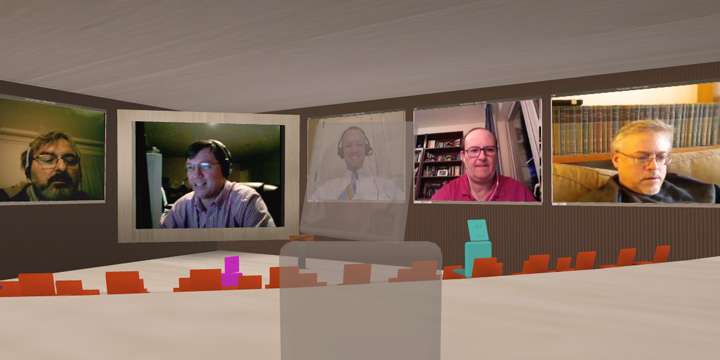
Turing Church Online Workshop 2, OpenQwaq, Sunday December 11


The Turing Church Online Workshop 2 will be held on Sunday, December 11, 2011, with a format similar to the Turing Church Online Workshop 1 on November 20, 2010, beginning at 9am PST (noon EST, 5pm UK, 6pm Continental EU).

The Workshop will explore transhumanist spirituality and “Religion 2.0″, the convergence of science and religion, highly imaginative future science and technologies for resurrection, emerging science and technologies for immortality, social and memetic engineering.

The technical implementation of the Workshop will be managed by teleXLR8 using the OpenQwaq VR technology. There are a limited number of seats available for those who wish to attend. On Sunday November 27 and Sunday December 4 at at 9am PST (noon EST, 5pm UK, 6pm Continental EU) there will be meetup and practice sessions for speakers and participants.


Some speakers in the pictures above.

Program: Turing Church online workshop 2 | KurzweilAI

Speakers, morning session, 9am PST to noon PST:
  • Giulio Prisco
  • James Hughes
  • Martine Rothblatt
  • Frank Tipler
  • Ben Goertzel
  • Remi Sussan
Speakers, afternoon session, 1pm PST to 4pm PST
  • Lincoln Cannon
  • Brent Allsop
  • Dan Massey
  • Andrew Warner
  • Mike Perry
  • Fred and Linda Chamberlain (pre-recorded talk)

Monday, November 7, 2011

Online talk next Sunday: Ken Hayworth on How to create a Connectome Observatory of the mouse brain and beyond

Ken Hayworth will give an online talk next Sunday Nov. 13 at 10am PST in teleXLR8, on How to create a Connectome Observatory of the mouse brain and beyond. If you wish to attend:
- If you have a teleXLR8 account created in 2011, you can just show up.
- If you have a teleXLR8 account created in 2010, I will need to create a new account for you. Please contact me.
Please read: IMPORTANT – invitations and logistics
http://telexlr8.wordpress.com/2011/08/19/important-invitations-and-logistics/


How to create a Connectome Observatory of the mouse brain and beyond | KurzweilAI
http://www.kurzweilai.net/how-to-create-a-connectome-observatory-of-the-mouse-brain-and-beyond

Dr. Kenneth Hayworth will present an online talk and Q/A on How to create a Connectome Observatory of the mouse brain and beyond on Sunday, November 13, at 10am PST.

He will present a plan to map the mouse brain at very high resolution.

The talk will be in teleXLR8, a 3D interactive video conferencing space. Please contact the organizers if you wish to attend the talk.

Hayworth is a postdoctoral fellow at Harvard University, a co-founder of the Brain Preservation Foundation, and designer of the Automatic Tape-Collecting Lathe Ultramicrotome (ATLUM), which could allow efficient nanoscale imaging of brain tissues.

“In 100 years, if we have the technology to bring someone back, it won’t be in a biological body,” he said in a New York Times article last year. “It is these scanning techniques and mind-uploading that, I think, will bring people back. This is a taboo topic in the scientific community. But we have a cure to death right here. Why aren’t we pursuing it?”

See also:
Ken Hayworth on How to create a Connectome Observatory of the mouse brain and beyond, OpenQwaq, November 13 2011, 10am PST | teleXLR8
http://telexlr8.wordpress.com/2011/09/24/ken-hayworth-on-how-to-create-a-connectome-observatory-of-the-mouse-brain-and-beyond-openqwaq-november-13-2011-10am-pst/

Sunday, August 28, 2011

teleXLR8, a telepresence community for cultural acceleration, now based on open source virtual reality and video software

Space Collective | teleXLR8, a telepresence community for cultural acceleration, now based on open source virtual reality and video software


The teleXLR8 online talk program based on OpenQwaq has been covered by Hypergrid Business “as an online open TED, using modern telepresence technology for ideas worth spreading, and as a next generation, fully interactive TV network with a participative audience.“

At the end of 2010 the teleXLR8 project, based on the industrial strength commercial Teleplace platform, was put on hold waiting for funding.

In May 2011 Teleplace made the visionary decision to open source their technology as OpenQwaq. This permits continuing teleXLR8 as a free, invitation-only program based on OpenQwaq, with more frequent talks, workshops and conferences.

In August 2011 the teleXLR8 project has been re-launched. See my short presentation Welcome to the 2011 season! The first talk has been announced by KurzweilAI: “teleXLR8 is reopening on Sunday 21 10 a.m. PST with a talk by [experimental quantum physicist/programmer] Suzanne Gildert on Hack the Multiverse!. The teleXLR8 online talk program is “a telepresence community for cultural acceleration,” as their blog puts it. Translation: an audiovideo seminar — think TED in Second Life, plus webcam videoconferencing and video session recording."

Suzanne outlined the basics of Quantum Computing, described the the D-Wave One quantum computer, and explained how to program it. For those who missed the talk, the full video coverage is on the teleXLR8 video channel on YouTube.

The teleXLR8 project will continue with more frequent talks, seminars, online conferences and mixed-reality extension of traditional conferences, interviews, talk shows, and e-learning courses. Thanks to the built-in video recording feature of OpenQwaq, we will post the full video coverage to our video sharing channels on Blip.tv, Youtube and Vimeo after a few days. Participation in the realtime interactive sessions is free, but invitation-only: if you wish to participate, please contact us, join the mailing list or the groups on Facebook and Linkedin, and ask for an invitation.

Read more on Space Collective...

Sunday, August 7, 2011

SecondPlace, QwaqLife or TeleSim?

I am very much in love with both my two favorite virtual meeting technologies: Second Life, partly cloned by the open source OpenSim, and Teleplace, recently open sourced as OpenQwaq. In the pictures, two recent online conferences in Second Life and Teleplace.


I love both, but most VR users tend to strongly prefer one. I am interested in "serious" applications to, for example, online talks and e-learning (no value judgment intended, and please see "Telepresence Education for a Smarter World" for more), and I like both.


The Teleplace / OpenQwaq technology, on which my teleXLR8 online talk program and "telepresence community for cultural acceleration" is based, has much better built-in voice and support for multi user collaboration, document sharing and webcam videoconferencing, all very important features for "serious" applications, but those who prefer Second Life may find it too aseptic and square.

The Second Life / OpenSim technology, much closer to (and directly inspired by) the Metaverse of Snow Crash, has a certain built-in playfulness which is also very important (more important than I used to think) for "serious" applications, and is much more appealing to persons with strong artistic sensibilities, but those who prefer Teleplace may find its more, um, extreme aspects too annoying and distracting.

As I said, I like both. The "conflict" is mostly cultural and psychological, and I have no doubts that both technologies, especially in their open source versions, can easily support both work and play in both square and creative modes. For example, I have prototyped simple examples of videoconferencing and collaborative document sharing in Second Life, and OpenQwaq can import very creative 3D models and avatars.

Open ended, comments welcome.

Friday, July 8, 2011

Suzanne Gildert on Hack the Multiverse!, OpenQwaq, August 21 2011, 10am PST


UPDATE – NEW DATE: Sunday, August 21, 2011, at 10am PST (1pm EST, 6pm UK, 7pm continental EU)

The new phase of the teleXLR8 project will start with a talk by one of the most popular speakers of the first phase in 2010. Suzanne Gildert will give an interactive online talk on "Hack the Multiverse!", using the new open source OpenQwaq telepresence technology, on Sunday July 31 2011, at 10am PST.

Suzanne is currently working at D-Wave Systems, Inc. See the D-Wave blog "Hack the Multiverse". See the announcement and abstract of Suzanne's talk. OpenQwaq is one of the best 3D applications for telework, online meetings, group collaboration, and e-learning in a virtual 3D environment (v-learning). There are a limited number of seats available, please contact us if you wish to attend. Join our mailing list, our Facebook group, or our Linkedin group.

Sunday, November 21, 2010

The Turing Church of transhumanist spirituality, online in virtual reality for people and pets

The Turing Church Online Workshop 1, on Saturday November 20 2010 in Teleplace, explored transhumanist spirituality and “Religion 2.0″ as a coordination-oriented summit of persons, groups and organizations active in this area. See my report with pictures and videos.


Here I prefer to show this picture of three participants with their pets before the formal start of the workshop. On the left video screen I am holding my sweet little Sacha, who is NOT a cat like the other two pets but a Shih-Tzu doggy with her own Facebook page. En passant, last week we webcast Sacha's 12th birthday party on Facebook via Livestream, see the picture below and the video on YouTube.


Back to the Turing Church Online Workshop 1. Topics and issues discussed:

- To discover parallels and similarities between different organizations and to agree on common interests, agendas, strategies, outreach plans etc.
- To discuss whether it makes sense to establish a umbrella organization, or to consider one of the existing organizations as such.
- To develop the idea of scientific resurrection: our descendants and mind children will develop “magic science and technology” in the sense of Clarke’s third law, and may be able to do grand spacetime engineering and even resurrect the dead by “copying them to the future“. Of course this a hope and not a certainty, but I am persuaded that this concept is scientifically founded and could become the “missing link” between transhumanists and religious and spiritual communities.
- And of course, how to make our our beautiful ideas available, understandable and appealing to billions of seekers.


The workshop made evident that the participants, persons and groups, share very similar, overlapping and compatible ideas. It is also evident that there are different approaches to transhumanist spirituality, each with its own focus and priorities. Some participants observed that, since all of the spiritual transhumanist groups represented at the workshop are inclusive, it makes sense joining all (I am a member of all the groups represented at the workshop which have a formal concept of membership, and I consider myself a member of the others as well). The idea of establishing a umbrella organizations for spiritually inclined transhumanists was discussed. An alternative is one of the existing groups, or perhaps Humanity+ (subject to their interest of course) as umbrella organization. The MTA and Terasem reported significant growth.

My own presentation was very similar to my talk on The Cosmic Visions of the Turing Church at the Transhumanism and Spirituality Conference 2010, with some new elements. In particular I added a few references to Possibilianism, a middle, exploratory ground between religion and atheism first defined by neuroscientist David Eagleman in relation to his book of fiction Sum. Eagleman: "I call myself a Possibilian: I'm open to ideas that we don't have any way of testing right now... Our ignorance of the cosmos is too vast to commit to atheism, and yet we know too much to commit to a particular religion… with Possibilianism I'm hoping to define a new position -- one that emphasizes the exploration of new, unconsidered possibilities. Possibilianism is comfortable holding multiple ideas in mind; it is not interested in committing to any particular story." This makes a lot of sense to me, and I consider myself as a Possibilianist and a Cosmist. Our universe is a very big place with lots of undiscovered and unimagined "things in heaven and earth" which science will uncover someday, and perhaps in this mysterious and beautiful complexity there will be room for the old promises of religion.

This was a great workshop of 4 very intense hours and a lot of interesting things were said. I don't have the time to write a full report, please watch the videos.

Tuesday, October 26, 2010

TransVision 2010, October 22-24, 2010

TransVision 2010 is over! I wish to thank all speakers and participants, those who came to Milan and those who participated remotely via Teleplace. Special thanks to Kim for her work at the main Teleplace workstation and for handling many technical problems, and to Cosimo and Jacopo for their work at the HD video camera. I wish to thank the volunteer Italian to English translator (I am not mentioning your name here because I guess you prefer it this way, but you know who you are and thank you so much), who gave also a great unscheduled presentation of the Polytopia Project. And of course I also want to thank Riccardo and Stefano for their support in organizing and running the conference. In particular Stefano should really have stayed at home to recover from recent surgery, but he made a special effort to be with us.


In the first two pictures, Dan Massey and Max More giving their talks. In the foreground, the Terasem 1 O'Neill Island One Space Habitat, a Bernal sphere model built by Simon Deering for the Terasem Movement of Martine Rothblatt and presented at TV10 by Khannea Suntzu. The model is now on its way to Florida to be delivered to the Terasem Movement. We had many great talks, not only about visionary technologies but also about literature, politics, philosophy and art. The second half of the first day has been dedicated to Italian neo-Futurist literary and artistic movement, but strike neo- because Futurism is always Neo by definition. I have been disappointed by not seeing as many people as I hoped: I counted about 65 participants in Milan over 3 days including a dog. The problem is that participating in conferences costs money and time, and in my own presentation (which I shortened to less than ten minutes to make time for other speakers) I proposed online conferences 2.0 as a solution.


We had about 30 remote participants in the in the TVirtual online extension of TransVision 2010, hosted by the teleXLR8 project based on the Teleplace online telepresence platform. Remote participants have been able to watch all talks in realtime, and interact with speakers and other participants. In the picture above, Max More's talk is shown to remote participants in Teleplace, and the virtual Teleplace conference hall is shown to the participants in Milan. We used two Teleplace workstations, one to stream the video and voice of the speaker and to interact with remote participants, and one to stream the speaker's slides. Lesson learned: if the text on the slides is small it is better to upload also the original .ppt or .pdf to Teleplace. We did this in realtime during the conference, but we should have done it in advance. For those speakers without presentations in .ppt or .pdf, we used the second Teleplace workstation to show the audience in Milan to the audience in Teleplace.


In the afternoon of the second day we have reversed the procedure outlined above and shown remote talks from speakers in Teleplace to the audience in Milan. After great talks by Eugen Leitl and Robert Geraci, Natasha Vita-More started her talk (picture above)... but 20 minutes into Natasha's talk all the Internet connections in the conference hall in Milan died, perhaps due to overload caused by too many WiFi connections in parallel (about 10 participants were using the hotel's WiFi connection). The Internet service provider's technicians could not fix the problem. The remote participants in Teleplace continued without us, and we have video recordings of the talks by remote speakers. However, all remote speakers have been invited to repeat their talks to the teleXLR8 community.


In the morning of the third day, not only the Internet connections in the conference hall were still dead, but also the screen projection system was dead! I had a (very) heavy-handed "exchange of views" with the hotel's personnel (wife says I can be quite unpleasant on occasions), and the technical problems were fixed.

This was a very interesting event, with great talks by great speakers. I am happy to have seen again many old friends and made many new ones. In the picture above, some speakers and participants at a dinner after the end of the conference. I was not really able to pay attention to any of the talks including my own, and I look forward to watching the video coverage. We recorded everything on video, both in HD with the cameras on site, and from Teleplace. The videos will be available online and on the conference's DVD proceedings. The videos recorded in Teleplace will be available online in a few days, and those recorded on site in a few weeks.

I have started two blog posts as containers and index pages for material to be posted later. Both posts have the same title as this one. The post on the TransVision 2010 blog will have links to the HD videos recorded in Milan, and the post on the teleXLR8 blog has links to the videos recorded in Teleplace. The Twitter feed created by participants at #TV2010 has the twitting history of the conference.

UPDATE - (almost) full video coverage recorded in Teleplace.
UPDATE - Transhumanist Science, Futurist Art, Telepresence and Cosmic Visions of the Future at TransVision 2010 @ KurzweilAI

Tuesday, October 19, 2010

My presentation at TransVision 2010: Online conferences 2.0

My presentation at TransVision 2010: Online conferences 2.0

One problem with conferences is that participating costs money and time. Today many conferences offer live video streams of all talks and discussion, which is very important for those who cannot attend physically. Some recent conferences like the ASIM 2010 Conference in San Francisco (satellite to the Singularity Summit 2010) have offered fully interactive remote participation with multi-user video, audio, text and document sharing (“mixed-reality”).


Mixed-reality via modern telepresence technology permits opening conferences to remote participants by merging on-site and remote participants in one virtual group. The 2-way video and audio link enables each participant, on-site or remote, to be seen and heard by all other participants, on-site or remote. Remote speakers and attendees are able to actively participate, follow the talks via interactive video streaming, ask questions to the speakers, contribute to the discussion, and give talks themselves. Of course, modern telepresence technology permits also online-only “conferences 2.0″, and I think this is an important trend. Going back to “one problem with conferences is that participating costs money and time“, it is evident that online conferences 2.0 permit saving a lot of money and time, thus enabling more people to participate in cultural acceleration.


I will present our teleXLR8 project based on Teleplace, recently covered by Hypergrid Business, one of the best online magazines focused on professional applications of virtual reality, “as an online open TED, using modern telepresence technology for ideas worth spreading, and as a next generation, fully interactive TV network with a participative audience.” See also “teleXLR8 Project News – a telepresence community for cultural acceleration“, our mini-manifesto Telepresence Education for a Smarter World on the IEET site and the interview MIND and MAN: Getting Mental with Giulio Prisco, by Natasha Vita-More, on H+ Magazine.

Sunday, October 17, 2010

teleXLR8 on Hypergrid Business as "online TED", Teleplace talk on BCI

The teleXLR8 project has been covered by Hypergrid Business, one of the best online magazines focused on professional applications of virtual reality, "as an online open TED, using modern telepresence technology for ideas worth spreading, and as a next generation, fully interactive TV network with a participative audience."

The Hypergrid Business article has the first public indications of the monthly membership fee for teleXLR8: $15, or $10 if paid annually. See this administrative note for more details.


I am organizing the TransVision 2010 conference in good old brickspace, and unfortunately many people will not be able to come for the usual reasons: money and time. Of course, the conference will be open to remote participants and speakers via teleXLR8. I am persuaded that, with Teleplace, telepresence technology has achieved critical performance, usability and immersion for online-only conferences, and I believe more and more conferences will move online.

Later today (or tomorrow morning depending on where you are: Sunday October 17, 2010, at 10am PST, 1pm EST, 6pm UK, 7pm CET) Max Hodak will give a talk in Teleplace on Brain-machine interfacing: current work and future directions. In the picture above, Max lectures in Teleplace. UPDATE: This was a great talk. About 30 participants attended the talk and contributed to the discussion with very interesting questions and comments. For those who could not attend we have recorded everything (talk, Q/A and discussion) on video.

Brain-Machine Interfacing (BMI), or Brain-Computer Interfacing (BCI) is one of the emerging technologies which will start having a very big impact in the next decade of the 10s. From the abstract of Max' talk: "Fluid, two-way brain-machine interfacing represents one of the greatest challenges of modern bioengineering. It offers the potential to restore movement and speech to the locked-in, and ultimately allow us as humans to expand far beyond the biological limits we’re encased in now."

See also "teleXLR8 Project News - a telepresence community for cultural acceleration", our mini-manifesto Telepresence Education for a Smarter World on the IEET site and the interview MIND and MAN: Getting Mental with Giulio Prisco, by Natasha Vita-More, on H+ Magazine. Besides the existing Facebook Group and Linkedin Group, we have created a teleXLR8 mailing list on Google Groups. Please feel free to join the mailing list to discuss the project.

Sunday, October 3, 2010

TransVision 2010 Conference to be streamed live interactively in Teleplace

Those who wish to attend the TransVision 2010 conference and community convention (October 22, 23 and 24 in Milan, Italy) but cannot come to Milan will have the option to participate remotely in the TVirtual online extension, watch all talks in realtime, and interact with speakers and other participants. TVirtual, hosted by the teleXLR8 project based on the Teleplace online telepresence platform, will be a mixed-reality event similar to the recent ASIM 2010 Conference.


TVirtual tickets are available at a very reduced price. Those who register for the full 3-days TVirtual before or on Sunday, October 10, including of course those who have registered already, will receive a free yearly membership in teleXLR8. Those who register for the full 3-days TVirtual after this date will be offered a 50% discount for yearly membership in teleXLR8. Current teleXLR8 beta account holders will be welcome to participate in TVirtual.

If you choose to attend TVirtual, you will be able to watch all talks, see and talk to speakers and other participants, and attend special telepresence sessions during, before and after the conference. In the pictures above, a TV10 planning session and several TransVision 2010 speakers giving talks in Teleplace at recent events. Please see the teleXLR8 website for full video coverage of recent transhumanist talks.

For a more detailed description of the objectives of our online events program, see our mini-manifesto Telepresence Education for a Smarter World on the IEET site and the interview MIND and MAN: Getting Mental with Giulio Prisco, by Natasha Vita-More, on H+ Magazine. See also teleXLR8 Project News – a telepresence community for cultural acceleration.

Friday, September 24, 2010

teleXLR8 Project News - a telepresence community for cultural acceleration

We have been running the teleXLR8 project, a telepresence community for cultural acceleration based on Teleplace, in semi-stealth beta mode for a few months since the first talk by Anders Sandberg on Neuroselves and exoselves: distributed cognition inside and outside brains on April 18, 2010. We have produced some great events, talks by well known experts of futuristic technologies, meetings of closed working groups, and a two day "mixed reality" satellite workshop with the Singularity Summit 2010.


teleXLR8 has been running as a free, invitation-only beta on the Teleplace servers and network infrastructure since March 2010. Due to the limited resources available we have only promoted teleXLR8 in the relatively small community of future studies and "Singularity" enthusiasts. Even so, we have received many more requests to join than we could handle, and the project has been frequently covered by the blogosphere and the online press. The current beta group has about 80 members. Each talk has been recorded on video and posted to the video sharing site blip.tv the day after the talk. The videos have been seen by several thousands of viewers and covered by important technology oriented sites including internetACTU, IEET, KurzweilAI, H+ Magazine, Next Big Future and Slashdot.

We have now reached an agreement with Teleplace, which will permit running the project in fully operational mode our own dedicated servers, network and support infrastructure, and opening it to everyone for a very reasonable membership fee. The current beta will continue until the start of the next phase, and all members of the current beta group will receive extended free membership. Sponsor slots are available.


We will produce great and frequent online events, featuring first class speakers with world-changing ideas, available in interactive realtime telepresence. teleXLR8 can be thought of as an online open TED, using modern telepresence technology for ideas worth spreading, and as a next generation, fully interactive TV network with a participative audience. In the pictures, participants are watching the recent talk by Ben Goertzel on TV. At any moment, they can step in to comment, discuss and ask questions.

For a more detailed description of the project's goals, see our mini-manifesto Telepresence Education for a Smarter World on the IEET site and the interview MIND and MAN: Getting Mental with Giulio Prisco, by Natasha Vita-More, on H+ Magazine.

Besides the existing Facebook Group and Linkedin Group, we have created a teleXLR8 mailing list on Google Groups. Please feel free to join the mailing list to discuss the project.

Sunday, September 19, 2010

VIDEO: Martine Rothblatt on Reconstructing Minds from Software Mindfiles, Teleplace, September 18

Martine Rothblatt gave an ASIM Expert Series talk in Teleplace on “Reconstructing Minds from Software Mindfiles” on Saturday September 18, 2010.


Some questions and comments from the audience have been of a philosophical nature and related to preservation of self (whatever that is), but most of those who attended the talk were already prepared to accept that, depending on the amount of information stored and the accuracy of the reconstruction process, the upload copy may be (and feel like) a valid continuation of the original self. The talk and the discussion have been more focused on actual technologies and technical issues: How to extract enough information? How to prove that the information extracted is enough? How to quantify a critical treshold? How to make sure that nothing really important is left behind? How to reconstruct a thinking and feeling mind from a database? Martine gave a detailed presentation of the preliminary implementation of software mindfiles in her twin projects CyBeRev and LifeNaut (similar, but kept separate mainly as a fail-safe measure) and their forthcoming mobile clients and integration with social networks.

Thanks Martine for the great talk and thanks to the (about 25) participants who contributed to the discussion with very interesting questions and comments. For those who could not attend we have recorded everything (talk, Q/A and discussion) on video. Here is a direct link to a video.

Friday, September 17, 2010

REMINDER - Martine Rothblatt on Reconstructing Minds from Software Mindfiles, Teleplace, September 18, 10am PST

REMINDER - Martine Rothblatt will give an ASIM Expert Series talk in Teleplace on “Reconstructing Minds from Software Mindfiles” on Saturday September 18, 2010, at 10am PST (1pm EST, 6pm UK, 7pm CET). Those who already have Teleplace accounts for teleXLR8 can just ahow up at the talk. There are a limited number of seats available for others, please contact me if you wish to attend. You can also join the Facebook page for the event.


Abstract: “I do think, however, there is a (natural) tendency to way overestimate the importance of copying our brain structure to copying our minds. I think our minds will be uploadable in good enough shape to satisfy most everyone by reconstructing them from information stored in software mindfiles such as diaries, videos, personality inventories, saved google voice conversations, chats, and chatbot conversations. The reconstruction process will be iteratively achieved with AI software designed for this purpose, dubbed mindware.“

I met Martine online earlier today to prepare the talk. She told me that, in previous presentations of software mindfiles, many questions and comments have been of a philosophical or metaphysical nature and related to preservation of self (whatever that is). But I told Martine that I believe most of those who will attend the talk tomorrow are already prepared to accept that, depending on the amount of information stored and the accuracy of the reconstruction process, the upload copy may be (and feel like) a valid continuation of the original self. I expect that the audience will prefer leaving philosophy aside and be more interested in actual technologies and technical issues: How to extract enough information? How to prove that the information extracted is enough? How to quantify a critical treshold? How to make sure that nothing really important is left behind? How to reconstruct a thinking and feeling mind from a database? See also ASIM Experts series: Reconstructing Minds from Software Mindfiles on carboncopies.org and the discussion in the article MIND and MAN: Getting Mental with Giulio Prisco on H+ Magazine. Watch also the short movie Bina48 Robot on YouTube (latest update of the video in the New York Times article).

Martine Rothblatt is an American lawyer, author, and entrepreneur. Rothblatt graduated from UCLA with a combined law and MBA degree in 1981, then began work in Washington, D.C., first in the field of communication satellite law, and eventually in life sciences projects like the Human Genome Project. She is currently the founder and CEO of United Therapeutics. In 2004, Rothblatt launched the Terasem Movement, a transhumanist school of thought focused on promoting joy, diversity, and the prospect of technological immortality via personal cyberconsciousness and geoethical nanotechnology. The purpose of the CyBeRev (cybernetic beingness revival) project of the Terasem Movement is to prevent death by preserving sufficient information about a person so that recovery remains possible by foreseeable technology.

Teleplace is one of the best 3D applications for telework, online meetings, group collaboration, and e-learning in a virtual 3D environment (v-learning). Those who already have Teleplace accounts for teleXLR8 can just ahow up at the talk. There are a limited number of seats available for others, please contact me if you wish to attend. You can also join the Facebook page for the event.

Monday, September 13, 2010

Martine Rothblatt on Reconstructing Minds from Software Mindfiles, Teleplace, September 18, 10am PST

Martine Rothblatt will give an ASIM Expert Series talk in Teleplace on “Reconstructing Minds from Software Mindfiles” on Saturday September 18, 2010, at 10am PST (1pm EST, 6pm UK, 7pm CET). Those who already have Teleplace accounts for teleXLR8 can just ahow up at the talk. There are a limited number of seats available for others, please contact me if you wish to attend. You can also join the Facebook page for the event.


Abstract: “I do think, however, there is a (natural) tendency to way overestimate the importance of copying our brain structure to copying our minds. I think our minds will be uploadable in good enough shape to satisfy most everyone by reconstructing them from information stored in software mindfiles such as diaries, videos, personality inventories, saved google voice conversations, chats, and chatbot conversations. The reconstruction process will be iteratively achieved with AI software designed for this purpose, dubbed mindware.“

Martine Rothblatt is an American lawyer, author, and entrepreneur. Rothblatt graduated from UCLA with a combined law and MBA degree in 1981, then began work in Washington, D.C., first in the field of communication satellite law, and eventually in life sciences projects like the Human Genome Project. She is currently the founder and CEO of United Therapeutics. In 2004, Rothblatt launched the Terasem Movement, a transhumanist school of thought focused on promoting joy, diversity, and the prospect of technological immortality via personal cyberconsciousness and geoethical nanotechnology. The purpose of the CyBeRev (cybernetic beingness revival) project of the Terasem Movement is to prevent death by preserving sufficient information about a person so that recovery remains possible by foreseeable technology.

Teleplace is one of the best 3D applications for telework, online meetings, group collaboration, and e-learning in a virtual 3D environment (v-learning). Those who already have Teleplace accounts for teleXLR8 can just ahow up at the talk. There are a limited number of seats available for others, please contact me if you wish to attend. You can also join the Facebook page for the event.

H+ Magazine - MIND and MAN: Getting Mental with Giulio Prisco

H+ Magazine - MIND and MAN: Getting Mental with Giulio Prisco


I have been interviewed by Natasha for H+ Magazine. See H+ Magazine - MIND and MAN: Getting Mental with Giulio Prisco. We talk about a bit of everything, telepresence, cyberspaces and metaverses, the transhumanist movement and the enabling role of telecom technology, life extension, mind uploading (oops sorry, substrate-independent minds), transcending biology and becoming substrate-independent minds, Randal and Suzanne's ASIM initiative (Advancing Substrate-Independent Minds, see carboncopies.org) including the online workshops and the recent mixed-reality ASIM 2010 Conference in San Francisco, moving from biological to robotic and virtual bodies, and the Teleplace -based teleXLR8 project, a “telepresence community for cultural acceleration” focused on science and technology education and outreach (with a transhumanist flavor). Perhaps we talk also of other things, the article is long.

Ben Goertzel on The Cosmist Manifesto in Teleplace, September 12

Ben Goertzel gave a talk in Teleplace on his recent book “A Cosmist Manifesto: Practical Philosophy for the Posthuman Age” on Sunday September 12, 2010.


This talk was somewhat different from previous talks, and centered on a high level philosophical vision rather than on specific emerging technologies. But these are two sides of the same coin and, as it is well known, cultural and philosophical trends have a deep influence on technology development and vice versa. Thanks Ben for the great talk and thanks to the (about 25) participants who contributed to the discussion with very interesting questions and comments. For those who could not attend we have recorded everything (talk, Q/A and discussion) on video.

A Cosmist Manifesto: Practical Philosophy for the Posthuman Age, by Ben Goertzel, has been published by Humanity+ Press and is available on Amazon. See the review “A Cosmist Manifesto, an Advocacy“ on H+ Magazine. See also the online version of the Cosmist Manifesto.

The term Cosmism was introduced by Tsiolokovsky and other Russian Cosmists around 1900. Goertzel’s “Cosmist Manifesto” gives it new life and a new twist for the 21st century. Cosmism, as Goertzel presents it, is a practical philosophy for the posthuman era. Rooted in Western and Eastern philosophy as well as modern technology and science, it is a way of understanding ourselves and our universe that makes sense now, and will keep on making sense as advanced technology exerts its transformative impact as the future unfolds. Among the many topics considered are AI, nanotechnology, uploading, immortality, psychedelics, meditation, future social structures, psi phenomena, alien and cetacean intelligence and the Singularity. The Cosmist perspective is shown to make plain old common sense of even the wildest future possibilities.

Ben Goertzel, Chair of Humanity+, is founder and CEO of two computer science firms Novamente LLC and Biomind LLC, and of the non-profit AGIRI (Artificial General Intelligence Research Institute). He has served as a university faculty in several departments of mathematics, computer science and cognitive science, in the US, Australia and New Zealand. He is author of two books focused on the future of technology and society Creating Internet Intelligence (Plenum, 2001) and The Path to Posthumanity (Academica, 2006). He serves as Director of Research for the Singularity Institute for AI.

Teleplace is one of the best 3D applications for telework, online meetings, group collaboration, and e-learning in a virtual 3D environment (v-learning).

Thursday, September 9, 2010

REMINDER – Ben Goertzel on The Cosmist Manifesto in Teleplace, September 12, 10am PST

Ben Goertzel will give a talk in Teleplace on his recent book “A Cosmist Manifesto: Practical Philosophy for the Posthuman Age” on Sunday September 12, 2010, at 10am PST (1pm EST, 6pm UK, 7pm CET). Those who already have Teleplace accounts for teleXLR8 can just ahow up at the talk. There are a limited number of seats available for others, please contact me if you wish to attend.


A Cosmist Manifesto: Practical Philosophy for the Posthuman Age, by Ben Goertzel, has been published by Humanity+ Press and is available on Amazon. See the review “A Cosmist Manifesto, an Advocacy“ on H+ Magazine. See also the online version of the Cosmist Manifesto. In the picture above, Ben Goertzel (first from left) in a Teleplace meeting.

The term Cosmism was introduced by Tsiolokovsky and other Russian Cosmists around 1900. Goertzel’s “Cosmist Manifesto” gives it new life and a new twist for the 21st century. Cosmism, as Goertzel presents it, is a practical philosophy for the posthuman era. Rooted in Western and Eastern philosophy as well as modern technology and science, it is a way of understanding ourselves and our universe that makes sense now, and will keep on making sense as advanced technology exerts its transformative impact as the future unfolds. Among the many topics considered are AI, nanotechnology, uploading, immortality, psychedelics, meditation, future social structures, psi phenomena, alien and cetacean intelligence and the Singularity. The Cosmist perspective is shown to make plain old common sense of even the wildest future possibilities.

Ben Goertzel, Chair of Humanity+, is founder and CEO of two computer science firms Novamente LLC and Biomind LLC, and of the non-profit AGIRI (Artificial General Intelligence Research Institute). He has served as a university faculty in several departments of mathematics, computer science and cognitive science, in the US, Australia and New Zealand. He is author of two books focused on the future of technology and society Creating Internet Intelligence (Plenum, 2001) and The Path to Posthumanity (Academica, 2006). He serves as Director of Research for the Singularity Institute for AI.

Teleplace is one of the best 3D applications for telework, online meetings, group collaboration, and e-learning in a virtual 3D environment (v-learning). Those who already have Teleplace accounts for teleXLR8 can just ahow up at the talk. There are a limited number of seats available for others, please contact me if you wish to attend.

Wednesday, September 8, 2010

Suzanne's talk in Teleplace slashdotted - Separating Hope From Hype In Quantum Computing


Suzanne Gildert's talk on Quantum Computing in Teleplace of September 4 has been covered by Slashdot Hardware Story | Separating Hope From Hype In Quantum Computing.

Of course the "Slashdot effect" (via Next Big Future | Quantum Computing: Separating Hope from Hype) has caused a massive surge of visits to the article on the teleXLR8 website and especially the teleXLR8 video channel on blip.tv (several thousands of video views in a few hours).

As it is usually the case, the comments on Slashdot are often off-topic and sometimes rude (there are some very interesting comments though). But I think a popular site like Slashdot is very useful to bring science closer to the citizens (this is not a "hardware story" but a fascinating and accessible scientific lecture), and I am happy that many people have had the opportunity to watch the talk on video.